

I’m honored that my essay
The Cry That Carries
was selected as the Karen Kao 2025 Creative Nonfiction Flash Essay contest winner by Sweet Lit.
Named in honor of writer Karen Kao, the contest carries forward a legacy of thoughtful, resonant storytelling. This essay first found its home with Sweet Lit, which feels meaningful, but I wanted to post it here too, to hold onto the moment and share it with this community.
The judges comments: “The Cry That Carries weaves together sound and silence, a reminder that one cannot exist without the other. Here metaphor grows and grows, becomes the loud “cry” of the essay, that siren call of need, yet the silence of addiction echoes with haunting resolve. In such a short space, Kimberly Kearns’s essay reverberates outwards, shivers in a stilled body of water, a reminder that sometimes we don’t hear those things that tether us to the world.”
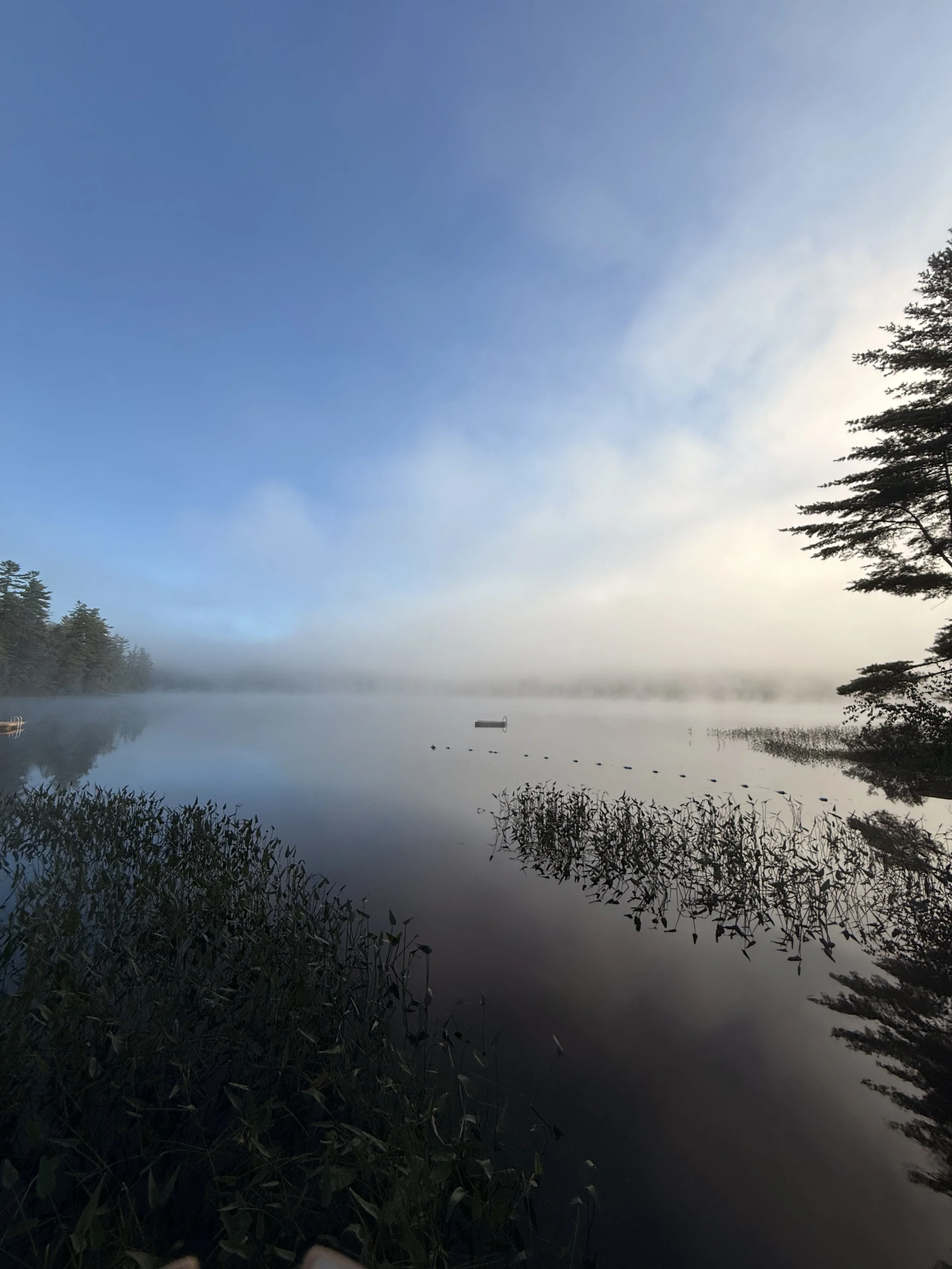
I hear the mournful call of the loon. The deep, lonely sigh echoes off the mountaintops. Tumbling across the surface of the silk-like water, I welcome its haunting embrace. Waves kiss my feet but bugs are biting now. Still, I stay, waiting for the lonely cry again, while a muted sky stretches before me in purples and pinks, fading into dusky starlight. I search for red eyes floating atop rippling, inky black. Layers of opaque glass shimmer. I am alone.
~
Bathed in the dim kitchen light, the frigid air is a shock against the skin of my naked legs. Twisting my left ankle over my right, goosebumps crawl across a blanket of pale flesh. I curl my toes up underneath my bare feet for warmth. There’s no point in keeping the refrigerator door open. My bed calls to me, but still, my body stays anchored in place.
~
“Ooooh…” a loon wails. I bet it’s a male. The ominous tone varies, the cadence shifts, depending on who they’re talking to and what they want to say. Howling and chatting far away. A tremolo means they’re in trouble. Yodeling to say, “This is my home, back away.” But the final, most beautiful call, a chilling and desperate cry, whispers only to me.
~
The kitchen is bathed in darkness, except for the light coming from behind the milk carton, illuminating the bottle of half drank Sauvignon Blanc. I shift my weight and listen for tiny footsteps pitter-pattering down the front hallway stairs. But there is nothing. Only the quiet humming that comes from the back of the fridge. And the buzzing inside my head.
~
Baby loons are chicks. They ride on their parents’ backs when they are first born, to bond, to seek warmth, to escape the cold or to be far from predators that lurk below. I’ve always wanted to see a chick riding on their mama. I’ve never seen a baby loon before. I wonder if a chick has to learn how to talk.
~
I should go upstairs. To sleep. Crawl into bed beside my babies. They need me. Yet, I won’t stop playing this game. Shivering, my body trembles. It aches. I’m vibrating. I can’t shake the fact that I don’t recall putting any of my children to bed last night. I promised I wouldn’t do this tonight. Not tonight. Not again. Not anymore.
~
Pairs of loons call to one another. They create synchronized duets that strengthen their bonds. They sing back and forth. It’s how they talk and communicate. Crying across misty glass.
~
Inspecting the bottle, I attempt to decipher how much I drank last night. Because I can’t remember. I consumed half of this bottle and the entirety of the one hidden beneath the piles of recycling. Flattened boxes of mac ‘n cheese and empty jars of peanut butter, the Whispering Angel hides within a smushed box of the kid’s favorite sugary cereal.
~
These avian creatures only live for twenty years. That’s it. They never experience the joy of a 21st birthday. But maybe that’s considered a long time for birds.
~
Twisting off the top, the metal cap clicks against the glass brim as I dip my nose down towards the bottle. The pungent scent hits me, sharp and familiar. Sighing, the golden liquid sloshes. Just one taste.
~
I heard once that loons mate for life.
~
Clumsily, I spill some on the counter as it splashes into my glass. I contemplate licking up the puddle. I lift the glass and listen again. He’s not home yet. He won’t know. My lips suck thirstily, making a slurping noise in the quiet darkness. My cheeks pucker at the tartness. I place the cup on the counter. Tapping my foot on the floor, I count to five and then sip. Count to five. Sip. I try to wait, until I can no longer do so. I empty the glass, gulping it down without breathing. I chug greedily, straight from the bottle.
~
The call of the loon means something. It’s the sign of a healthy lake.
Flash Nonfiction Essay
When the Game Ends
by Kimberly Kearns
November 20, 2025
My daughter has this rubber mannequin head. It’s the size of a real, actual human head. It has long, silky blond hair that she combs and practices her French braiding technique on. It has all the delicate features of a real person, with elaborately painted light green eyes and full red lips that she once applied makeup to. The makeup never came off, so the mannequin ended up looking like a drag queen. And it’s just a head, no body, just a sizable noggin with a lot of hair and a long, slender neck.
We sometimes play this game in our house. It doesn’t have a name. It’s just a game where we hide things. It doesn’t have a start or an end. It just begins. Someone randomly starts it up in the hopes of annoying another member of the family, and it usually isn’t planned. I think sometimes it happens by accident.
Like that time a rogue navy and white striped sock ended up in my husband’s clean laundry. He handed it to me and said, “This isn’t mine.”
“Well, it’s not mine,” I said, throwing it back at him.
Thus began our game of hiding the sock. We’d sneak it under pillows, underneath piles of underwear in drawers, or inside closets, just to playfully get under each other’s skin. That one lasted quite a long time. Maybe a couple of months.
A few years ago, we played this game with a fake, plastic pile of dog poop, stashing it in various spots to surprise the kids, like in their lunchboxes, on the floor in their rooms, or tucked into their shoes.
I’m not sure who started hiding the mannequin head, but suddenly that mess of blond hair was everywhere. She began to make her way all over the house, turning up in bizarre places like on a shelf in the pantry or inside the shower. While most of us got a kick out of it, the mannequin head really bothered my oldest son.
He wasn’t so into the game anymore. He claimed her face creeped him out. Her eyes were weird, her makeup nightmarish. Every time the mannequin head found its way into his room, he threatened to shave off all her hair, making his sister scream and cry.
Eventually, the game started to wear on my husband too. He complained that being startled by her staring back at him from the kitchen cabinet at five a.m., half-asleep and reaching for his coffee mug, was getting to be too much.
So one day, I moved the mannequin to a shelf in the laundry room and didn’t bother to tell anyone. A few days passed, and the game was over.
Eventually, my daughter asked me what happened to her mannequin.
“Your brother didn’t like it,” I said. “She weirded him out.”
“Why? But I like her,” she complained.
“Sorry,” I said. “I think the game’s over.”
“Okay.” She frowned.
I took her hands and squeezed them tight. “How about I try to braid your hair, instead?”
Literary Publications